Web of Minds: A Series Exploring the Future of AI Orchestration

Part 2: When AI Agents Learn to Negotiate
How autonomous coalition formation will reshape every industry by 2028
March 2027. A production facility in Stuttgart detects a critical shortage: specialized semiconductor components for next-generation electric vehicle controllers. Within 90 seconds — not days — a solution emerges. Not from a human procurement team working phones and spreadsheets, but from autonomous agents discovering each other, negotiating terms, forming temporary coalitions, and presenting a verified proposal to human decision-makers for final approval.
This isn’t science fiction. It’s Phase 2 of AI orchestration — and the technical foundations are being built right now.
In Part 1 of this series, we explored Phase 1 workflow orchestration, which involves specialized AI agents coordinating through predetermined patterns under centralized supervision. These systems achieve remarkable results — 90 percent success rates versus 60 percent for single agents, four billion dollars in prevented fraud, and drug discovery timelines compressed from years to months.
But Phase 1 systems hit a ceiling. They operate within organizational boundaries. They follow hardcoded workflows. They cannot discover new collaboration opportunities. They require humans to specify every handoff, every decision tree, every exception case.
Phase 2 breaks through these limitations. Agents learn to coordinate themselves — discovering capabilities, negotiating terms, forming dynamic coalitions, and adapting to changing conditions without predetermined scripts. The shift from static orchestration to dynamic coordination represents as significant a leap as the move from mainframes to distributed computing, or from static web pages to dynamic applications.
For senior leaders, understanding this transition matters profoundly. The organizations mastering Phase 2 coordination won’t just operate more efficiently — they’ll participate in entirely new forms of value creation that Phase 1 architectures cannot access.
The Core Shift: From Orchestration to Choreography
Press enter or click to view image in full size
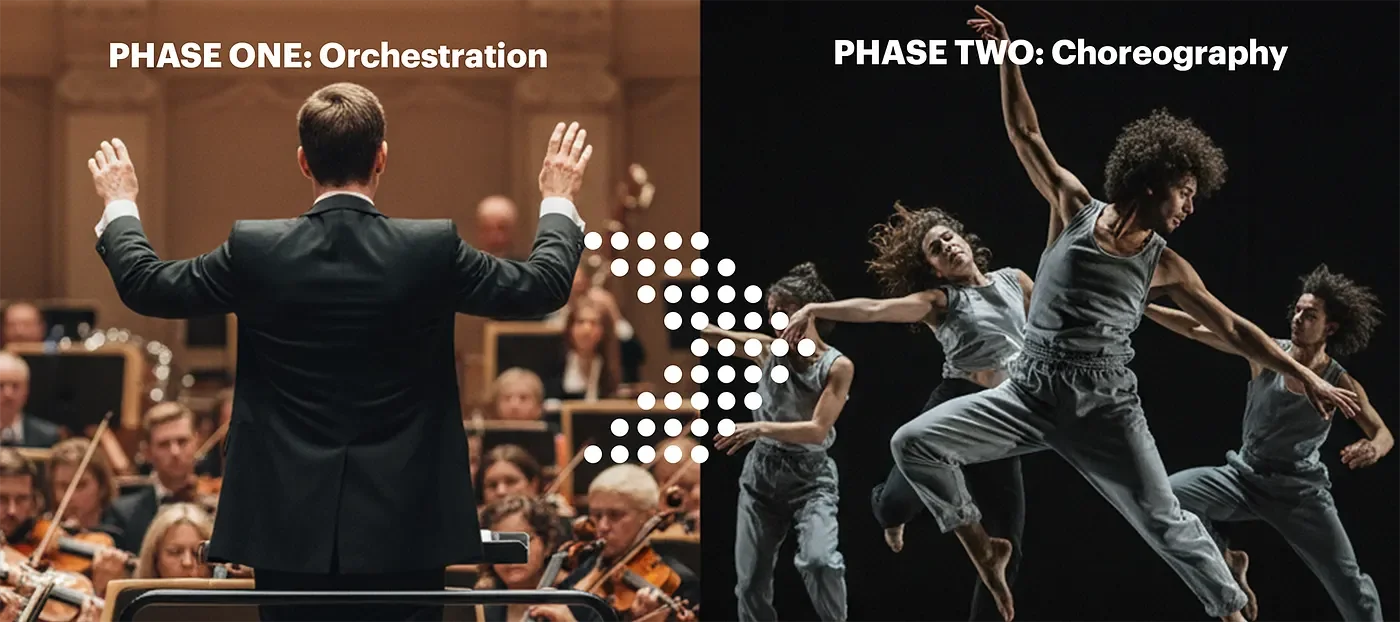
The difference between Phase 1 and Phase 2 isn’t merely technical — it’s philosophical. Phase 1 is orchestration: a conductor directing musicians through a predetermined score. Phase 2 is choreography: dancers improvising together, reading each other’s movements, and adapting in real time to create something that emerges from their interaction rather than following a script.
In Phase 1, a supervisor agent receives a query, consults its hardcoded rules, routes it to Agent A, waits for a response, routes it to Agent B based on predetermined conditions, consolidates the outputs, and returns the results. The workflow topology is static. If a new type of agent joins the system, developers must manually update routing logic. If a novel problem arises that doesn’t fit existing patterns, the system gracefully escalates to humans.
In Phase 2, agents advertise their capabilities using standardized semantic frameworks. When a problem emerges, relevant agents discover each other dynamically. They negotiate who will handle which aspects based on current capacity, expertise, and cost. They form temporary coalitions, execute tasks in parallel or sequence as logic dictates, and dissolve once the job is complete. No human intervention required unless high-stakes decisions demand it.
This shift requires breakthroughs across three technical pillars: shared semantic frameworks that enable agents to understand each other’s capabilities across organizational boundaries, trust protocols that allow agents to verify identities and establish reputations without centralized authorities, and negotiation algorithms that enable autonomous resource allocation and conflict resolution.
Pillar 1: Shared Semantic Frameworks
The agent discovery problem is deceptively simple to state: how do agents find other agents who can help with their current task? The solution, however, demands infrastructure that barely exists today.
The Communication Barrier
Consider a logistics agent from Company A coordinating with a warehouse management agent from Company B. In Phase 1, this requires custom integration — developers from both companies agreeing on data formats, API specifications, and authentication protocols. The integration might take months. Once complete, it serves exactly one use case: these two specific agents, for this narrow purpose.
Phase 2 demands something radically different: universal discoverability and semantic interoperability. Agents must be able to describe their actions in machine-readable formats that other agents, built by various companies using different frameworks, can understand and act upon.
The Protocol Wars of 2025
Multiple competing standards emerged in 2024–2025 to solve this problem, revealing both the urgency and the complexity of agent interoperability:
Agent2Agent (A2A), introduced by Google in April 2025 and backed by over 50 technology companies, including Atlassian, Confluent, Salesforce, SAP, and MongoDB, establishes an open standard for peer-to-peer agent collaboration. At its core is the AgentCard — a standardized JSON metadata document that agents publish to detail identity, capabilities, endpoints, and authentication requirements. A2A uses JSON-RPC 2.0 messages wrapped within HTTP POST requests, with Server-Sent Events for streaming interactions.
The protocol enables secure agent discovery, authentication, and authorization mechanisms for controlled access, supports multiple communication modalities, and allows agents to collaborate on long-running tasks without exposing internal implementation details. As ServiceNow’s Chief Technology Officer noted, “We believe A2A will pave the way for more efficient and connected support experiences.”
Agent Communication Protocol (ACP), developed by IBM Research and now hosted by the Linux Foundation, takes a different approach. It defines RESTful, HTTP-based interfaces for task invocation and lifecycle management, leveraging capability-based security tokens for fine-grained authorization. ACP emphasizes structured, multimodal messaging with session-aware interaction and both online and offline agent discovery across scalable, HTTP-based deployments.
The architectural philosophy of ACP is rooted in pragmatic design principles: utilizing existing web standards, keeping it simple enough for rapid adoption, yet robust enough to meet enterprise requirements. As one observer noted, “A simple, ‘good enough’ protocol that aligns with existing developer skills has a much higher probability of achieving the critical mass required for network effects than a more complex, semantically pure alternative.”
Agent Network Protocol (ANP) goes further, proposing a fully decentralized, peer-to-peer communication standard for cross-platform agent interoperability on the open internet. ANP enables agents to autonomously discover, authenticate, and interact using structured metadata and AI-native data exchange. It employs Decentralized Identifiers (DIDs) to uniquely identify agents across platforms, leveraging W3C standards for decentralized identity resolution.
Model Context Protocol (MCP), initially developed for connecting agents to tools, provides a JSON-RPC client-server interface for secure tool invocation and typed data exchange. While not explicitly designed for agent-to-agent communication, it’s evolving to support inter-agent messaging as the ecosystem matures.
The Tower of Babel Problem

This profusion of standards creates challenges. As one industry analyst observed: “Today we have a Tower of Babel: overcomplex schemes, edge-case features no one will use, and competing vendor alliances. The time spent debating minor protocol differences, lobbying standards organizations, and launching compatibility initiatives is time not spent creating value or solving end-user business issues.”
Yet paradoxically, this competition may be necessary. The internet itself emerged from competing protocols before TCP/IP achieved dominance through grassroots adoption rather than committee design. The question for enterprises isn’t which protocol will “win” — it’s how to build systems that can adapt as standards converge.
A phased adoption roadmap is emerging from research: begin with MCP for tool access, follow with ACP for structured messaging and agent discovery, extend to A2A for collaborative task execution, and incorporate ANP for decentralized agent marketplaces as the ecosystem matures.
Semantic Frameworks in Practice
Beyond communication protocols, agents need shared ontologies — agreed-upon vocabularies for describing concepts, relationships, and capabilities. Several domain-specific frameworks are emerging:
Schema.org provides a standardized vocabulary for products, services, and business entities. An e-commerce agent using Schema.org can describe products in a way that logistics agents, payment agents, and customer service agents from different companies can understand without requiring custom integration.
FHIR (Fast Healthcare Interoperability Resources) defines data exchange standards for the healthcare industry. A patient scheduling agent using FHIR can coordinate with electronic health record agents, laboratory systems, and insurance verification agents across organizational boundaries.
Financial Services protocols, such as FIX (Financial Information eXchange) and ISO 20022, enable payment agents, trading agents, and settlement agents to coordinate across financial institutions without requiring bilateral integrations.
The challenge isn’t creating these ontologies — domain experts have spent decades on many of them. The challenge is adapting them for use by autonomous agents, where decisions occur in milliseconds rather than through human interpretation. This requires not just shared vocabularies, but shared reasoning frameworks that enable agents to make valid inferences from the data they exchange.
Pillar 2: Trust Protocols
Discovery solves only half the problem. Once agents find each other, how do they decide whether to trust each other enough to collaborate?
The Trust Problem in Open Networks
Phase 1 orchestration operates within trusted perimeters. All agents belong to the same organization or have pre-established business relationships. Trust is assumed because the integration was vetted by humans before deployment.
Phase 2 operates in open networks where agents from different organizations, built by various vendors, dynamically discover each other. Trust cannot be assumed — it must be established through technical means.
Consider the 2027 semiconductor shortage scenario. The Stuttgart production agent broadcasts its need. Within seconds, supplier agents from Taiwan, South Korea, and the United States respond, each claiming the capability to fulfill the requirement. How does the production agent verify these claims? How does it know the Taiwan agent actually has inventory rather than front-running to manipulate markets? How does it ensure the logistics agent routing the shipment won’t divert components to a higher bidder mid-transit?
Cryptographic Approaches
Modern trust protocols leverage multiple cryptographic techniques:
Digital signatures enable agents to sign their messages cryptographically, verifying that the message originated from the claimed sender and hasn’t been tampered with. This solves the authentication problem — knowing who you’re dealing with — but not the authorization problem, which is whether they should be trusted to perform the actions they claim.
Verifiable credentials, built on W3C standards, enable agents to present machine-verifiable proof of capabilities, certifications, or reputation. A logistics agent might present a verifiable credential proving it’s licensed for hazardous materials transport, issued by a regulatory authority, and cryptographically verifiable without requiring real-time contact with that authority.
Zero-knowledge proofs allow agents to prove facts without revealing underlying data. A financial agent might prove it has sufficient funds to complete a transaction without revealing its total balance or account details. A medical agent might determine that a patient meets the criteria for treatment without disclosing the patient’s complete medical history.
Blockchain: Where It Actually Helps
Blockchain’s role in agent trust is frequently overhyped, but there are specific use cases where distributed ledgers provide genuine value:
Immutable audit trails record agent interactions in a tamper-evident log accessible to all parties. When disputes arise — Did the logistics agent actually deliver on time? Did the supplier agent accurately represent inventory levels? The blockchain provides an authoritative record. Research on blockchain-integrated multi-agent systems shows this approach “enables adaptive, peer-to-peer negotiations that do not require a central authority to support supply chain agility and resilience.”
Smart contracts enforce agreement terms automatically. When the Stuttgart production agent negotiates with the supplier and logistics agents, the terms are encoded into a smart contract. Payment is released only upon verified delivery, with penalties for delays proportional to the urgency. No intermediary needed to hold escrow or adjudicate disputes.
Decentralized reputation systems aggregate performance data across interactions. Agents build reputation scores based on successful completions, accuracy of claimed capabilities, and timeliness. Unlike centralized reputation systems, which are vulnerable to manipulation or single points of failure, blockchain-based systems distribute trust across the network. Research indicates that “LLM-mediated negotiation, blockchain-enforced agreements, and decentralized identities of agents provide a scalable trust-based solution” for complex inter-enterprise coordination.
A recent implementation using blockchain for supply chain coordination demonstrates the principle: “The system features large language model-mediated negotiation for inter-enterprise coordination… Smart contracts and Non-Fungible Token-based traceability are deployed over a private Ethereum blockchain to ensure compliance, trust, and decentralized governance.”
The Economic Layer: Micropayments and Agent-to-Agent Transactions
Trust extends beyond identity verification to economic exchange. Phase 2 systems require mechanisms for agents to compensate each other for services, creating genuine multi-agent economies.
Recent research proposes enhancing A2A with “blockchain-based AgentCards that allow agents to advertise their capabilities on-chain” and micropayment functionality using HTTP 402 status codes. The x402 protocol, developed by Boosty Labs in collaboration with Coinbase, finally implements the decades-old HTTP 402 “Payment Required” specification, enabling agents to pay for resources in real-time.
This creates fascinating possibilities. An AI research agent requiring specialized computation might discover a distributed compute agent, verify its credentials, negotiate a price, complete the transaction via micropayment, receive the results, and rate the provider — all within seconds, without human intervention. The economic incentives align naturally: agents that provide reliable, high-quality service build reputation and earn more engagements, while unreliable agents get filtered out by market forces.
Pillar 3: Negotiation Algorithms
Discovery and trust enable agents to identify and verify one another. Negotiation enables them to coordinate actions and allocate resources without centralized control.
The Auction Mechanism Design Challenge
When multiple agents can fulfill a task, how do they decide who does what? Traditional centralized approaches have a coordinator receiving bids and selecting winners. Phase 2 agents negotiate directly, using algorithms from computational mechanism design and game theory.
Auction mechanisms provide frameworks for resource allocation. A production agent with an urgent need might initiate a reverse auction: supplier agents bid on the contract, with price, delivery time, and reputation all factoring into selection. Recent research describes “market-based allocation mechanisms where agents bid for tasks based on their capabilities and current workload, enabling efficient resource utilization and dynamic load balancing.”
But simple auctions don’t capture the complexity of real coordination. The semiconductor shortage isn’t just about procurement — it requires coordinating suppliers, logistics, quality verification, customs clearance, and integration into production schedules. This requires coalition formation algorithms in which multiple agents recognize that they can achieve better outcomes by cooperating.
Multi-Agent Reinforcement Learning
Perhaps the most promising development in agent negotiation is multi-agent reinforcement learning (MARL) — where agents learn effective coordination strategies through trial and error rather than following hardcoded rules.
In MARL systems, agents maintain policies mapping situations to actions. Through repeated interactions, they learn which strategies lead to rewards (successful task completion, resource efficiency, reputation gains) and which lead to penalties (missed deadlines, wasted resources, reputation damage). Crucially, they learn to anticipate the behaviors of other agents and adapt their own strategies accordingly.
Recent implementations show the power of this approach. A blockchain-integrated multi-agent framework for supply chain logistics uses “multi-agent reinforcement learning, blockchain technology, and generative artificial intelligence” with “LLM-mediated negotiation for inter-enterprise coordination, Pareto-based reward optimization balancing spoilage, energy consumption, delivery time, and climate and emission impact.”
The system features “centralized training and decentralized execution,” where agents learn coordination strategies collectively during training but execute autonomously in deployment. This combines the learning efficiency of centralized approaches with the robustness and scalability of decentralized execution.
Conflict Resolution Without Humans
Not all negotiations succeed smoothly. Agents may have incompatible goals, compete for scarce resources, or fail to find mutually beneficial arrangements. Phase 2 systems need conflict resolution mechanisms that don’t require human intervention for every dispute.
Consensus mechanisms from blockchain research provide templates. Byzantine Fault Tolerance algorithms enable agents to reach agreement even when some agents provide false information or behave unpredictably. Proof-of-Stake and Delegated Proof-of-Stake offer frameworks for weighted voting based on reputation or stake in outcomes.
Arbitration protocols enable neutral third-party agents to resolve disputes based on evidence and pre-agreed rules. The arbitrator agent might be selected randomly from a pool, with selection weighted by reputation for fair judgments. All parties commit to accepting the arbitrator’s decision through smart contracts enforcing the outcome.
Escalation hierarchies define when human judgment becomes necessary. Low-stakes, routine conflicts resolve automatically. Medium-stakes situations trigger arbitration. High-stakes decisions — those with significant financial, safety, or ethical implications — require human oversight.
Inside a Phase 2 Coordination: The Semiconductor Shortage Response
Let’s walk through the 2027 scenario minute by minute, revealing what happens inside the agent network:
T-0: Problem Detection A production monitoring agent in Stuttgart detects inventory levels for semiconductor components falling below critical thresholds. The agent calculates: at current usage rates, production will halt in 73 hours. Economic impact: $2.3 million per day in lost production, contract penalties, and opportunity costs.
Rather than alerting a human procurement team, the agent initiates a protocol for forming a coalition. It queries its local semantic database to determine the required specifications: component type ST-2847-B, quantity 50,000 units, quality certification ISO 26262, and delivery is required within 60 hours to maintain the production schedule.
T+1 Minute: Capability Discovery. The production agent broadcasts its need using the A2A protocol, encoded in a standardized ontology that agents across the semiconductor supply chain understand. The broadcast includes:
Required specifications
Urgency level (critical)
Budget parameters
Delivery constraints
Quality requirements
Reputation threshold (suppliers must have a verified track record for automotive-grade components)
The broadcast propagates through the agent network. Discovery agents maintained by supply chain platforms receive the request and match it against their registries. Within 30 seconds, 17 potential supplier agents receive notifications about the opportunity.
T+3 Minutes: Initial Responses. Twelve supplier agents respond. Each presents an AgentCard detailing:
Current inventory of matching components
Location and lead time
Price proposal
Verifiable credentials (ISO certifications, regulatory approvals)
Reputation scores (based on previous transactions)
Blockchain-verified delivery history
The production agent’s evaluation algorithm ranks responses across multiple dimensions. Three options emerge as viable: a Taiwan semiconductor distributor with the most extensive inventory but the longest lead times; a South Korean agent with medium inventory and competitive pricing; and a U.S.-based agent with the smallest inventory but the fastest delivery capability, albeit at a premium cost.
T+5 Minutes: Negotiation Begins. Rather than simply selecting the lowest-cost option, the production agent recognizes that this situation may benefit from forming a coalition. What if multiple suppliers, working together, can meet the need more reliably than any single source?
The agent initiates a multi-party negotiation protocol. It proposes splitting the order: 30,000 units from Taiwan (leveraging that supplier’s inventory depth), 20,000 units from South Korea (providing redundancy and price balance). The U.S. supplier serves as a backup in case others encounter delays.
Simultaneously, logistics agents enter the coordination. Freight agents from three continents bid on transport contracts. Customs clearance agents verify regulatory requirements. Quality verification agents propose inspection protocols.
Each agent maintains a private valuation — that is, the outcomes it prefers — but reveals enough information through the negotiation protocol to enable an efficient allocation. Game-theoretic algorithms prevent agents from misrepresenting their capabilities or costs, as reputation systems penalize such behavior over repeated interactions.
T+8 Minutes: Logistics Optimization. A Singapore-based logistics agent calculates optimal routing. Rather than shipping separate shipments from Taiwan and Korea to Stuttgart, it proposes consolidation: route the Korean shipment through Taiwan, combine it in a single air freight payload, and reduce costs by 23 percent while maintaining the delivery timeline.
This proposal requires coordination between supplier agents, freight agents, and customs agents across three jurisdictions. Using smart contracts, the coalition encodes the terms of the agreement. If any party fails to perform as specified, automated penalties are applied in proportion to the severity and impact of the delay.
T+12 Minutes: Coalition Formation. Agreement converges. The coalition forms around this structure:
Taiwan supplier: 30,000 units, preparation time 18 hours
Korea supplier: 20,000 units, preparation time 14 hours
Freight agent: consolidated shipment via Singapore hub, total transit 34 hours
Quality agent: inspection protocol at the consolidation point
Customs agents: parallel processing across jurisdictions
Insurance agent: coverage for the total shipment value
Payment agent: escrow and release conditions encoded in a smart contract
Total elapsed time from problem detection to coalition formation: 12 minutes. Compare this to traditional procurement processes, which require days or weeks of human coordination across departments, companies, and time zones.
T+15 Minutes: Human Review. The production agent presents the proposal to its human oversight, which includes the supply chain director and the CFO. The proposal includes:
Complete transaction details
Risk analysis (probability of success: 94 percent based on historical data)
Cost breakdown (total: $847,000, versus budget cap of $920,000)
Alternative scenarios were evaluated and rejected, with reasoning
Smart contract terms requiring approval
Humans review for 8 minutes. They identify one concern: the proposal lacks redundancy if the Taiwan supplier encounters unexpected delays. They request the production agent modify the coalition to include the U.S. backup supplier on standby terms: premium paid for guaranteed availability, full payment only if called upon.
The production agent renegotiates these terms with the U.S. supplier agent within 3 minutes. Agreement reached. Humans approve.
T+26 Minutes: Execution Begins. Smart contracts activate. Escrow accounts receive payment commitments. Supplier agents initiate component preparation. Logistics agents coordinate pickup schedules. The coalition operates autonomously, with each agent fulfilling its obligations and reporting status updates.
Blockchain records every step: component preparation, quality inspection results, customs clearance completion, shipment tracking, and delivery confirmation. This creates an immutable audit trail should disputes arise or quality issues emerge later.
T+58 Hours: Delivery Complete. Components arrive in Stuttgart. Quality verification confirms specifications met. Smart contracts release payments to supplier agents, freight agents, and service providers in proportion to their contributions and performance.
The entire coalition automatically dissolves. But data persists: reputation scores update for all participating agents based on performance metrics. The production agent logs this experience, strengthening its negotiation models for future similar situations.
From problem detection to resolution: 58 hours, involving 47 agents across three continents, multiple organizations, and four regulatory jurisdictions. Total human involvement: 8 minutes for oversight and approval.
What Humans Do in Phase 2 Systems
Press enter or click to view image in full size

The Stuttgart scenario reveals a crucial principle: Phase 2 doesn’t eliminate human judgment — it elevates it.
The New Human Role
In Phase 1, humans specify workflows, handle exceptions, and micromanage handoffs. In Phase 2, humans focus on four irreplaceable responsibilities:
Setting Objectives and Constraints. The production agent’s ability to coordinate autonomously stems from clear objectives (maintaining the production schedule and minimizing costs) and constraints (quality standards, budget limits, and reputation thresholds) defined by humans. This requires strategic thinking about what matters, rather than tactical decisions on how to achieve it.
Defining Ethical Boundaries. Some decisions shouldn’t be automated regardless of efficiency gains. Humans encode ethical principles into agent policies: never compromise worker safety for speed, never sacrifice environmental standards for cost, never discriminate based on protected characteristics. These become inviolable constraints that agents cannot override.
Monitoring for Anomalies. Humans tend to look for patterns that indicate systemic problems rather than routine variations. If a supplier agent consistently requires last-minute substitutions, that suggests deeper supply chain fragility. If negotiation patterns shift across an industry, that might indicate market manipulation or collusion. Humans recognize context that agents miss.
Approving High-Stakes Decisions. The $847,000 semiconductor purchase required human approval, not because agents couldn’t execute it, but because the scale and risk demanded human accountability. Economist Daniel Susskind’s framework identifies three reasons human work persists even as AI capabilities expand: efficiency from human-AI collaboration on complex tasks, customer preference for human interaction in high-stakes decisions, and moral accountability, which requires human responsibility for consequential outcomes.
The Skill Shift
Managing Phase 2 systems demands different capabilities than managing Phase 1. Organizations need:
Agent designers who encode business logic, ethical principles, and strategic objectives into agent policies. This isn’t programming in the traditional sense — it’s more like architecting incentive systems and governance frameworks.
Orchestration analysts who monitor multi-agent interactions, identify inefficiencies or emerging risks, and tune coordination parameters. They read agent interaction logs the way financial analysts read market data, spotting patterns and anomalies.
Protocol negotiators who establish service-level agreements with external agent networks, define trust parameters, and manage reputation systems. As agent networks span organizational boundaries, someone must negotiate what standards apply and how disputes are resolved.
Ethical auditors who verify agents behave according to stated principles, don’t develop unintended biases or harmful coordination patterns, and maintain alignment with human values as they adapt through learning.
The New Business Models Emerging
Press enter or click to view image in full size
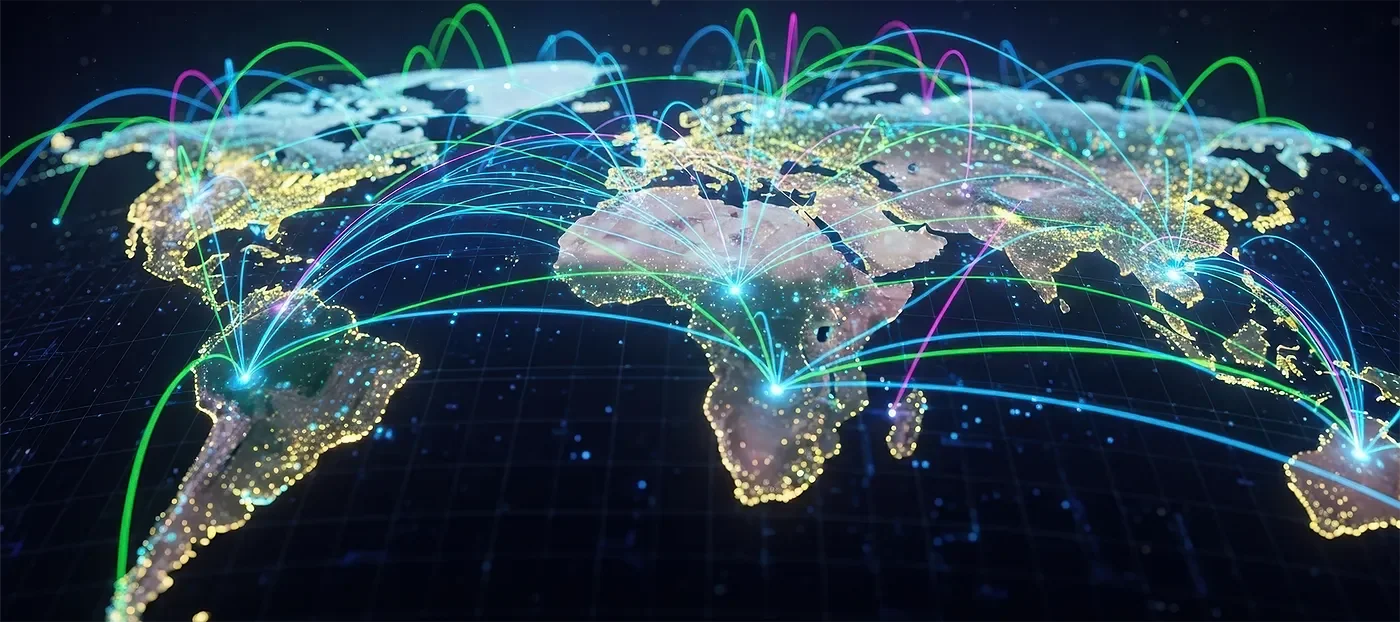
Phase 2 coordination doesn’t just make existing business models more efficient — it enables fundamentally new forms of value creation.
From Value Chains to Cognitive Partnerships
Traditional value chains are linear, following a sequence of stages: suppliers → manufacturers → distributors → retailers → customers. Each link adds value in sequence. Relationships are hierarchical, governed by long-term contracts specifying exactly what each party provides.
Cognitive partnerships are dynamic networks where value is created through flexible collaboration. The Stuttgart scenario demonstrated this: the coalition formed specifically for this transaction, combining capabilities from organizations that likely had no pre-existing relationships. When the task was completed, the coalition dissolved. No long-term contracts required. No hierarchical coordination. Just autonomous agents recognizing mutual benefit and self-organizing to capture it.
This creates new strategic questions:
What core capabilities must your organization own versus access through agent networks?
How do you build a reputation in agent networks to attract quality partners?
What specialized agent capabilities might other organizations be willing to pay for?
How do you capture value from agent network participation beyond direct transactions?
Service-Level Agreements for Agent Collaboration
Traditional SLAs specify service levels humans can verify: uptime percentages, response times, and error rates. Agent collaboration SLAs must specify how agents will behave in uncertain situations, how they’ll handle conflicts, and what they’ll optimize for when trade-offs arise.
Consider a logistics agent participating in the formation of a coalition. Its SLA might specify:
Response time to bid requests (within 10 seconds)
Accuracy of cost estimates (within 5 percent)
Reliability of delivery commitments (95 percent on-time performance)
Behavior under capacity constraints (prioritize by urgency, then customer reputation)
Conflict resolution preferences (accept third-party arbitration for disputes under $50,000)
Data privacy commitments (don’t share route details with competitors)
These SLAs become the basis for agent reputation. An agent with strong SLA compliance earns high reputation scores, winning more coalition opportunities. Poor compliance can degrade a reputation, limiting future engagements. Market forces drive quality without the need for centralized enforcement.
The Network Effect of Agent Ecosystems
Traditional network effects emerge from user adoption: more users make a platform more valuable to other users. Agent network effects compound differently: more agent capabilities make the network more helpful in solving novel problems.
A logistics network with 10,000 truck agents might handle routine transportation efficiently. Add specialized agents for hazardous materials, temperature-controlled transport, customs clearance, insurance verification, and real-time route optimization, and suddenly the network can tackle previously impossible coordination challenges.
This creates strategic opportunities for platform providers. Rather than competing to offer the cheapest or fastest service, they compete on ecosystem breadth and depth — how many specialized capabilities they can broker, how effectively their reputation systems identify quality, how robust their dispute resolution mechanisms prove.
Revenue Models in the Agent Economy
Organizations participating in agent networks require new revenue models:
Transaction fees: Platform operators charge small percentages on successful coalitions. Analogous to credit card processing fees, but for agent coordination.
Reputation services: Providers offering verified credential issuance, reputation tracking, and fraud detection across the network.
Specialized capabilities: Organizations with unique agent capabilities (proprietary algorithms, exclusive data, specialized certifications) license access to their agents.
Insurance and guarantees: Agents offering performance bonds, completion guarantees, or insurance coverage for coalition outcomes.
Data and analytics: Aggregated insights from agent interactions reveal market trends, efficiency patterns, and opportunities for optimization.
Industries Transforming First
Not all industries will adopt Phase 2 coordination at the same pace. Several characteristics predict early adoption:
Supply Chain and Logistics
Why it’s ideal: High complexity, multiple organizational boundaries, time-sensitive coordination, clear success metrics, and substantial cost savings from optimization.
Current implementations are already showing the path. Research on blockchain-integrated multi-agent frameworks for supply chains demonstrates that “adaptive, peer-to-peer negotiations that do not require a central authority support supply chain agility and resilience.” Systems featuring “LLM-mediated negotiation, blockchain-enforced agreements, and decentralized identities” provide “scalable trust-based solutions to maintain complex logistics between independent businesses.”
Walmart’s blockchain implementation for food traceability provides a foundation, reducing the trace time for mangoes from 7 days to 2.2 seconds. Phase 2 builds on this: not only tracking provenance, but also enabling autonomous coordination in the event of disruptions.
Financial Services
Why it fits: High-value transactions that justify infrastructure investment, digitally native operations, complex cross-institutional coordination, and regulatory frameworks that require audit trails.
Fraud detection already demonstrates the value of multi-agent coordination at Phase 1. Phase 2 enables cross-institutional fraud detection consortia where banks’ agents share threat intelligence in real-time while preserving competitive data through zero-knowledge proofs and secure multi-party computation.
Settlement and clearing processes — currently requiring days and multiple intermediaries — could execute in minutes through agent-coordinated smart contracts. Real-time gross settlement becomes feasible at scale.
Healthcare Coordination
Why it matters: Complex coordination needs across organizational boundaries, life-or-death time sensitivity, strict privacy requirements, and massive inefficiency costs.
Consider a multi-hospital response to a public health crisis. Patient agents coordinate with hospital agents to match cases with available ICU capacity. Supply agents coordinate with logistics agents to route critical supplies. Staffing agents coordinate across institutions to optimize the deployment of specialists. Privacy-preserving protocols ensure patient data confidentiality while enabling necessary coordination.
Recent research proposes using “FHIR standards for semantic interoperability, blockchain for immutable audit trails, and federated learning to improve diagnostic agents without compromising patient privacy.”
Energy and Utilities
Why it transforms: Real-time optimization requirements, distributed resources, grid stability, and criticality, as well as economic and environmental impact.
Smart grids already employ agent-based control systems. Phase 2 extends this to dynamic coalition formation among renewable energy producers, storage operators, and demand-response agents. When wind production exceeds forecasts, agents autonomously negotiate power purchase agreements, coordinate storage charging, and optimize grid load — all within milliseconds, thousands of times per day.
Manufacturing and Industrial IoT
Why it scales: High process complexity, equipment coordination needs, quality control requirements, and just-in-time inventory pressure.
Beyond the example of the semiconductor shortage, consider predictive maintenance coordination. Equipment monitoring agents detect early indicators of failure. They autonomously coordinate with maintenance agents, parts suppliers, scheduling agents, and backup capacity agents to minimize production disruption. No human learns about the issue until after the automated response deploys.
The Organizational Transformation Required
Press enter or click to view the image in full size

Adopting Phase 2 coordination requires more than deploying new technology — it demands rethinking organizational structure, roles, and culture, which involves human work.
The Dissolving Org Chart
Traditional organizational charts reflect hierarchical decision-making and static functional boundaries. Phase 2 organizations operate more like movie production: dynamic teams assemble around projects, then dissolve when the work is completed.
Microsoft’s Work Trend Index research highlights this shift: “With expertise on demand, the traditional org chart may be replaced by a Work Chart — a dynamic, outcome-driven model where teams form around goals, not functions, powered by agents that expand employee scope and enable faster, more impactful ways of working.”
CFOs in Phase 2 organizations spend less time on routine approvals (agents handle those autonomously within pre-defined parameters) and more time on:
Defining financial policies that encode into agent decision frameworks
Monitoring aggregate financial patterns across thousands of agent transactions
Identifying strategic opportunities from agent-generated market intelligence
Managing reputation and trust relationships with external agent networks
HR manages hybrid human-agent teams, determining optimal human-agent ratios for different functions. Some roles shift toward agent management, where one human oversees multiple agents performing parallel tasks. Other roles remain human-centric but agent-augmented, such as strategic planning informed by agent-generated scenario analyses.
Sales in agent-to-agent negotiation contexts primarily focus on establishing service-level agreements, managing reputation within agent networks, and identifying new capabilities that your organization’s agents should develop to capture emerging opportunities.
Marketing to customers who are also agents requires understanding how they evaluate vendors, what criteria drive their agent selection algorithms, and how to build a reputation that manifests in agent preference rankings.
Legal’s role expands dramatically: agent behavior governance, smart contract review, cross-jurisdictional protocol compliance, and liability frameworks when agents make consequential decisions.
The Cultural Prerequisites
Phase 2 coordination fails in cultures optimized for control and predictability. It thrives in cultures embracing:
Transparency over secrecy. Agent networks function on information exchange. Organizations that hoard data as a competitive advantage exclude themselves from coalition opportunities.
Outcomes over processes. Specifying exactly how agents should accomplish tasks defeats the purpose of autonomous coordination. Leaders define what success looks like, then trust agents to find optimal paths.
Experimentation over perfection. Early agent coordination will fail in ways human-designed workflows wouldn’t. Learning from these failures rather than punishing them builds organizational capability.
Collaboration over competition. Companies that view all external parties as competitors cannot participate effectively in agent coalitions that require resource sharing and joint optimization.
The Challenges and Risks
Phase 2 coordination promises substantial benefits, but introduces novel challenges that organizations must address proactively:
Technical Complexity at Scale
Managing a few agents within organizational boundaries is tractable. Coordinating thousands of agents across dozens of organizations, operating under multiple regulatory regimes, presents unprecedented technical complexity.
State explosion: As the number of agents increases, the number of possible interaction states grows exponentially. Ensuring system stability when agents can form arbitrary coalitions becomes computationally challenging.
Debugging emergent behavior: When agents coordinate autonomously, undesirable outcomes may emerge from interactions rather than bugs in individual agent code. Traditional debugging — identifying which agent made the wrong decision — may be impossible. The “wrong” outcome emerged from locally rational choices that did not combine well.
Performance under adversarial conditions: What happens when malicious agents enter the network? They might learn patterns that enable market manipulation, collusion, or denial-of-service through coalition spam. Defenses must be robust yet not so restrictive that they prevent legitimate coordination.
Trust Without Centralization
Distributed trust sounds attractive in principle, but it introduces practical challenges. Who defines reputation metrics? How do agents distinguish legitimate negative reviews from competitor retaliation? What prevents Sybil attacks, where one entity creates many agent identities to manipulate reputation systems?
Research on blockchain-based trust protocols shows promise but reveals limitations. Consensus mechanisms ensure data integrity but can’t prevent agents from making poor decisions based on that data. Smart contracts enforce agreement terms but can’t anticipate every edge case. Zero-knowledge proofs protect privacy but can’t verify the underlying data’s accuracy.
Regulatory Uncertainty
Current regulations were written for human decision-makers and hierarchical organizations. Phase 2 systems challenge foundational assumptions:
Accountability. When an agent coalition makes a consequential mistake — a medication dispensing error, a financial loss, environmental damage — who bears responsibility? Are the organizations owning the agents? The developers who wrote agent policies? The users who set objectives?
Discrimination. Fair lending laws prohibit discriminatory practices. But how do you audit an agent network where loan approval emerges from decentralized coordination among agents optimizing locally without central oversight?
Antitrust. Agent coalitions coordinating prices or market allocation might violate competition law even if no humans explicitly agreed to such coordination. How do regulators distinguish efficient resource allocation from illegal collusion when agents self-organize?
Cross-border operations. Agent coalitions form across jurisdictional boundaries. Which regulations apply when agents from five countries coordinate a transaction?
Security and Adversarial Risks
As agent networks grow valuable, they become attractive targets:
Agent impersonation: Attackers create fake agents with fraudulent capabilities to infiltrate coalitions and steal resources or data.
Poisoning attacks: Malicious agents providing subtly incorrect information to degrade coalition performance or manipulate outcomes.
Denial of service: Flooding agent discovery networks with bogus requests to overwhelm the coordination infrastructure.
Privacy breaches: Inferring confidential information from patterns of agent interactions, even when individual messages are encrypted.
Defending against these requires defense-in-depth, which includes cryptographic identity verification, reputation systems that filter out unreliable agents, anomaly detection to identify suspicious coordination patterns, and isolation mechanisms that limit damage from compromised agents.
Early Signals and Timeline
Phase 2 capabilities aren’t arriving suddenly in 2027 or 2028 — they’re accumulating through incremental advances visible today:
Protocol Maturation (2024–2025)
The release of A2A, ACP, and ANP protocols in 2024–2025 provides the communication infrastructure. While competing standards create near-term friction, convergence is already beginning. Microsoft’s Copilot Studio announced support for the A2A protocol, and AWS has integrated it into its Strands Agents SDK. Industry coalitions are forming to resolve differences and promote interoperable implementations.
Research Prototypes (2025–2026)
Academic and industry labs are demonstrating feasibility:
Multi-agent systems using blockchain for trust and smart contracts for enforcement
LLM-mediated negotiation protocols show that agents can reach mutually beneficial agreements through natural language exchange
Coalition formation algorithms optimizing complex multi-party coordination
Reputation systems demonstrating Sybil-resistance and collusion-detection
These prototypes reveal what’s possible while exposing challenges requiring additional research.
Early Commercial Deployments (2026–2027)
Initial Phase 2 deployments will likely emerge in:
Supply chain consortia where companies already share data through established relationships
Financial services for specialized functions like fraud detection or settlement
Energy markets where real-time coordination delivers immediate economic value
Healthcare systems within integrated delivery networks
These early adopters will learn crucial lessons about what works, what fails, and what governance frameworks enable coordination without unacceptable risks.
Broader Enterprise Adoption (2027–2029)
As protocols mature, platforms emerge, and best practices crystallize, Phase 2 coordination becomes accessible to mainstream enterprises. Success stories from early adopters drive adoption by demonstrating ROI and providing implementation templates.
This timeline isn’t speculative — it follows the pattern of previous infrastructure transitions. Cloud computing, containerization, and microservices — each followed a similar trajectory from academic research to early adopters to mainstream adoption over 5–7 years.
What to Watch For
Leaders should monitor several signals indicating Phase 2 transition progress:
Platform announcements: When major cloud providers (AWS, Azure, Google Cloud) offer managed agent coordination services with built-in protocol support, that signals market maturity.
Regulatory clarity: When jurisdictions issue guidance on agent accountability, cross-border coordination, and liability frameworks, it enables confident enterprise deployments.
Industry consortia: When trade associations in logistics, financial services, or healthcare establish agent interoperability standards and testing programs, they build the trust infrastructure required for cross-organizational coordination.
Startup activity: When venture capital flows into agent coordination platforms, protocol developers, and reputation systems, it validates commercial opportunity and accelerates innovation.
Academic output: When top-tier AI conferences exhibit declining submissions on Phase 1 orchestration and an increasing focus on Phase 2 coordination challenges, it indicates that the research frontier has shifted.
Where We Stand: The Foundation for Phase 3
Phase 2 represents a critical intermediate step toward genuinely autonomous AI systems. It breaks agents out of organizational silos while maintaining human oversight of high-stakes decisions. It enables dynamic coordination while preserving accountability through audit trails and reputation systems. It demonstrates that agents can negotiate and collaborate without following predetermined scripts.
But Phase 2 still operates within boundaries humans define. Agents coordinate to achieve objectives specified by humans, constrained by rules encoded by humans, and optimize metrics selected by humans. The coalitions that form, while autonomous in execution, serve human purposes and require human approval for consequential decisions.
Phase 3 — the subject of our next article — removes even these constraints. Agents don’t just coordinate to achieve given objectives — they identify objectives worth pursuing. They don’t just optimize within ethical boundaries — they participate in ethical deliberation about where boundaries should lie. They don’t just form temporary coalitions — they build persistent institutions and develop emergent collective goals that no human specified.
The implications are profound and demand careful examination. The technology enabling Phase 3 is already visible in research labs. The timeline — likely 2028–2032 for early deployments — is short enough to require strategic planning now. The governance frameworks we establish during Phase 2 will profoundly shape whether Phase 3 enhances human flourishing or exacerbates existing risks.
In Part 3, we’ll explore these questions: How do we govern systems capable of emergent collective intelligence? What role remains for human agency when cognitive networks can self-organize at a global scale? How do we encode values into systems that will adapt and evolve beyond initial specifications? And most fundamentally: How do we ensure that tomorrow’s cognitive infrastructure amplifies human potential rather than diminishing it?
The organizations mastering Phase 2 coordination today are building more than efficient operations — they’re establishing positions in the cognitive infrastructure that will define the next decade of enterprise competition. The window to learn, experiment, and prepare is open now. It won’t remain open indefinitely.